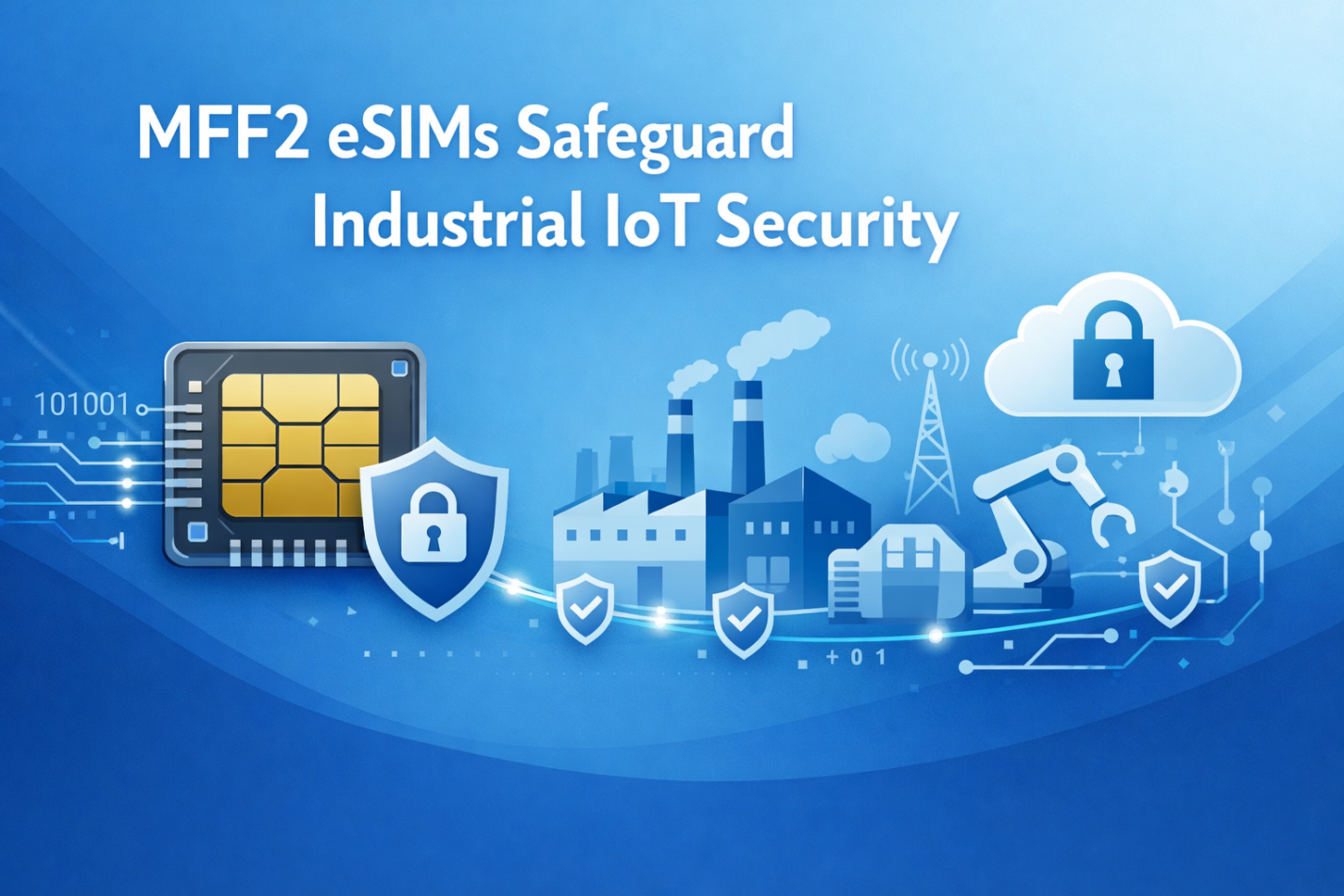
When deploying thousands of IoT devices in public spaces (such as smart water meters, vehicle trackers, or shared bicycles), connectivity security faces a significant risk: physical SIM card theft. Traditional removable cards are easily extracted and misused elsewhere. IoT eSIMs (embedded SIMs), particularly in MFF2 form, transform the SIM into a hard-to-remove permanent hardware component, substantially reducing the risks of SIM theft and abuse.
Understanding the MFF2 Form Factor
In the world of M2M (Machine-to-Machine) eSIM technology, the “MFF2” (M2M Form Factor 2) represents a paradigm shift from plastic cards to surface-mount components. Unlike the 2FF, 3FF, or 4FF cards we use in smartphones, an MFF2 eSIM card is a tiny silicon package—roughly 5mm x 6mm—designed to be soldered directly onto a device’s printed circuit board (PCB).
Further reading: IoT SIM Card Form Factors: 1FF, 2FF, 3FF, Nano (4FF) and MFF2
Integration Advantages of MFF2 eSIM:
- Soldered integration makes removal extremely difficult, preventing theft and replacement.
- Soldering process provides airtight, shock-resistant connections, eliminating failures from loose slots or poor mechanical contacts.
- Its compact design saves valuable space in wearables, small sensors, and industrial controllers, without needing physical card slots.
Key Specifications of MFF2 eSIM Card
| Feature | MFF2 Specification |
| Dimensions | ~5mm x 6mm |
| Packaging Type | QFN8 or DFN8 |
| Installation | SMT (Surface Mount Technology) Soldering |
| Operating Temp | -40°C to +105°C (Industrial Grade) |
| Lifespan | 10–15 years (Typical) |
| Standards Compliance | GSMA SGP.02 / SGP.22 / SGP.32 |
4 Major Advantages of MFF2 eSIM Card for Industrial Security and Stability
1. Permanent Soldering: The First Line of Defense Against Theft
The most immediate security benefit of a soldered MFF2 chip is the prevention of physical removal. In traditional IoT setups, a thief could open a device, pop out the SIM card, and insert it into a personal smartphone to consume data on the enterprise’s dime.
Why Soldering Stops Tampering:
- Hardware Binding: Because the chip is hard-wired to the PCB, it cannot be “swapped.” Removing it requires professional desoldering tools (such as a hot air rework station), which makes casual theft impossible.
- Visual Evidence: Any attempt to desolder the chip leaves obvious marks or heat damage. For critical infrastructure such as smart grids, a quick physical inspection can immediately confirm whether a device’s identity has been compromised.
- Anti-Vibration Reliability: In industrial or automotive applications, physical SIMs can “drift” or lose contact due to vibration. Soldered connections ensure the device stays online 24/7, preventing “denial of service” attacks caused by intentional or accidental mechanical failure.
2. Silicon-Level Security: The “Active Shield” Mechanism
Physical integration is only half the story. High-security IoT eSIM chips incorporate internal protections known as Active Shielding. This is a sophisticated layer within the silicon itself, designed to stop “intrusive attacks” in which an attacker might try to use microprobes to read data directly from the chip’s circuitry.
How Active Shielding Works:
- The Mesh Layer: The chip is covered with a fine metal grid carrying a pseudo-random bit sequence (PRBS).
- Continuous Monitoring: A monitoring module continuously checks the integrity of this signal in real time.
- The Response (Zeroization): If the mesh is broken—whether by a physical needle, a laser, or a focused ion beam (FIB)—the chip detects a signal disruption. It immediately triggers a self-destruct, or “zeroization,” protocol that erases the stored network keys (IMSI/KI) and the secure element’s memory.
This ensures that even if a sophisticated attacker desoldered the chip, they could not extract the sensitive credentials needed to clone the SIM or intercept encrypted communications.
3. Environmental Resilience for Industrial Reliability
The best eSIM solutions for IoT applications must survive where humans cannot. Traditional plastic SIM cards are prone to warping in high heat or corroding in humid environments. MFF2 chips are built to industrial and automotive grades (often AEC-Q100 certified).
- Extreme Temperatures: These chips operate reliably from -40°C to +105°C, making them ideal for outdoor sensors or engine-mounted telematics.
- Hermetic Sealing: Since the chip is vacuum-sealed during the manufacturing process, it is immune to oxidation and moisture, factors that frequently cause connection drops in standard removable SIMs.
4. Remote SIM Provisioning (RSP) and GSMA Standards
A common concern among procurement decision-makers is: “If the SIM is soldered, how do I change my carrier?” This is solved through Remote SIM Provisioning (RSP). Following the GSMA SGP.32 (the latest standard for IoT eSIMs), administrators can switch network profiles over-the-air (OTA) without ever touching the device.
Further reading: eUICC for 5G Industrial Routers: High-Bandwidth, Low-Latency Connectivity
Security Advantages of RSP:
- No Physical Logistics: You don’t need to send technicians to the field to swap cards, which reduces the “insider threat” risk.
- Encrypted Channels: Profiles are downloaded through secure TLS 1.3 encrypted tunnels.
- Zero-Touch Provisioning: Devices can be shipped globally with a “bootstrap” profile and automatically download a local, low-cost carrier profile once they reach their destination.
Zhongyi IoT’s IoT SIM Card Solutions
For a business, switching to MFF2-based M2M eSIM solutions is a strategic investment. If you are searching for the best eSIM solutions for IoT applications, Zhongyi IoT is your trusted partner. As a national high-tech enterprise and a leading 5G intelligent IoT service provider in China, we bring over 10 years of experience delivering cost-effective, globally competitive connectivity solutions.
Trusted by 3,000+ enterprise customers across 200+ countries and regions, we ensure reliable performance, scalable deployment, and responsive after-sales support for seamless IoT operations.
Seek leading IoT eSIM providers? Explore our range of M2M eSIM solutions and start your free trial today.
![Why 2G/3G/4G Backward Compatibility Still Matters for IoT in the 5G Era Alt: 2G/3G/4G in the 5G Era In the rush toward 5G and IoT (Internet of Things), it's easy to overlook the older networks that still power millions of devices. In the 5G era, backward compatibility with 2G/3G/4G remains crucial for IoT, primarily to ensure the proper operation of existing devices, provide wider coverage, reduce energy consumption and costs, and support a smooth transition. The Enduring Role of 2G/3G in a 5G World The shift to 5G is accelerating[1,2]. However, backward compatibility is not just about nostalgia; for several key reasons, it remains necessary both now and in the coming years: 1.Protecting the Online Operation of Existing IoT Devices Currently, there are hundreds of millions of IoT devices worldwide (such as smart electricity meters, water meters, gas meters, asset trackers, vehicle T-Boxes, alarm systems, etc.) that only support 2G, 3G, or 4G and lack 5G capabilities. Without backward compatibility or fallback to 2G/3G/4G, once operators shut down these legacy networks, devices will go offline directly, leading to business disruptions and security risks. 2.Coverage and Network Continuity In many rural, remote, or developing regions, 5G coverage is still limited, and even 4G is not fully available, while 2G/3G remains the most reliable wide-area communication method. Multi-mode NB‑IoT, LTE‑M, or Cat‑1/Cat‑4 modules supporting 2G/3G/4G can: Automatically downgrade to 4G, 3G, or 2G where 5G signals are weak Ensure devices such as vehicle trackers, logistics and warehouse monitors, and field environmental sensors “never go offline.” 3.Power Consumption and Battery Life Advantages 2G remains very efficient in low-speed, low-power scenarios. Some sensors or trackers using 2G solutions can operate 5–10 years without battery replacement. In comparison, 4G/5G consumes significantly more power in low-data scenarios. Therefore, retaining backward compatibility with 2G/3G/4G continues to provide the “most energy-efficient” connectivity option for low-power, long-lasting IoT devices. 4.Cost and Upgrade Pace Control The hardware costs and development thresholds for 2G/3G/4G modules and terminals are much lower than those for 5G modules, especially for high-volume, low-unit-price IoT products. With multi-mode and multi-band compatible modules, enterprises can: Gradually replace old devices with new 4G/5G modules over the next few years Instead of a “one-time replacement” when 2G/3G networks are shut down, thus controlling capital expenditure and operational costs 5. Transition Strategy and Network Downgrade Redundancy Backward-compatible multi-mode modules (supporting 2G/3G/4G/5G) provide flexibility for operators and customers: Operators can gradually shut down 2G/3G networks by country or region, first using 4G/5G for new services, while legacy devices continue to operate via downgraded connections; Devices can automatically downgrade to 4G/3G/2G when 5G signals are weak or congested, ensuring critical data is uploaded on time and avoiding the “high bandwidth but unreliable” problem. Practical Migration Paths The solution isn't to halt progress but to migrate strategically. Here’s how the industry is bridging the gap: Migration Path Terminology Core Advantages Use Cases Deployment Status(2026) LTE Cat-1 bis LTE Category 1 bis Simplified low-cost version of LTE 4G networks (bis = secondary optimized version) Leverages existing 4G base stations, moderate speed (10Mbps downlink), global roaming, low-cost modules Medium data volume IoT (e.g., POS terminals, vehicle tracking) Mainstream transition solution, covers all 4G areas LTE-M LTE-MTC (Machine Type Communication) Supports mobility, voice (VoLTE), 1Mbps speed, moderate penetration Mobile devices, voice-enabled IoT Strong coverage in Americas; expanding in Asia/Europe NB-IoT Narrowband IoT (Narrowband Internet of Things, single base station supports massive connections) Ultra-low power, strong penetration (+20dB), static low data rate (20-250kbps) Static sensors (e.g., meters, water meters, environmental monitoring) Leading deployment in Asia/Europe; limited in Americas 5G RedCap 5G Reduced Capability (eRedCap=enhanced version) Upgraded from Cat-1 bis, 150Mbps downlink, low power, massive connections Mid-to-high-end IoT requiring higher performance Commercial rollout starting 2026 in 5G coverage areas 5G NR mMTC 5G New Radio - massive Machine Type Communication 1M connections/km², ultra-low latency, network slicing Industry 4.0, smart cities Mature 5G network regions eSIM SGP.32 GSMA SGP.32 IoT eSIM (embedded SIM) international standard Remote operator switching, no card swaps needed, global roaming All cross-border IoT deployments Mainstream IoT eSIM standard in 2026 Contact Zhongyi IoT for IoT Connectivity Solutions From leveraging LTE Cat-1 bis for stability today to adopting flexible 5G eSIM solutions for tomorrow, businesses must ensure continuity while preparing for long-term evolution. This is why partnering with one of the top IoT connectivity providers is essential. Zhongyi IoT delivers a comprehensive IoT connectivity service designed to support seamless migration, global coverage, and remote management. To discover how the comprehensive IoT connectivity service can future-proof your deployments, visit Zhongyi IoT. References: [1]2G / 3G Network Shutdown Status and Challenges. Available at: https://www.smartviser.com/post/2g-3gnetworkshutdown [2]Technology upgrades and legacy network sunsets on the rise. Available at: https://www.gsma.com/connectivity-for-good/spectrum/technology-upgrades-and-legacy-network-sunsets-on-the-rise/ TDK SEO Title: Why 2G/3G/4G Backward Compatibility Still Matters for IoT in the 5G Era SEO Keywords: 5G and IoT, 2G 3G 4G, eSIM, IoT connectivity providers, IoT connectivity service SEO Description: Discover why maintaining 2G/3G/4G support is essential for IoT devices in the 5G era, and learn about multiple migration paths such as LTE Cat-1 bis, LTE-M, NB-IoT, and eSIM SGP.32. URL: /2g-3g-4g-backward-compatibility-matters-for-iot-5g-era/](https://www.zyiotnet.com/wp-content/uploads/2026/03/2g-3g-4g-in-the-5g-era.png)