
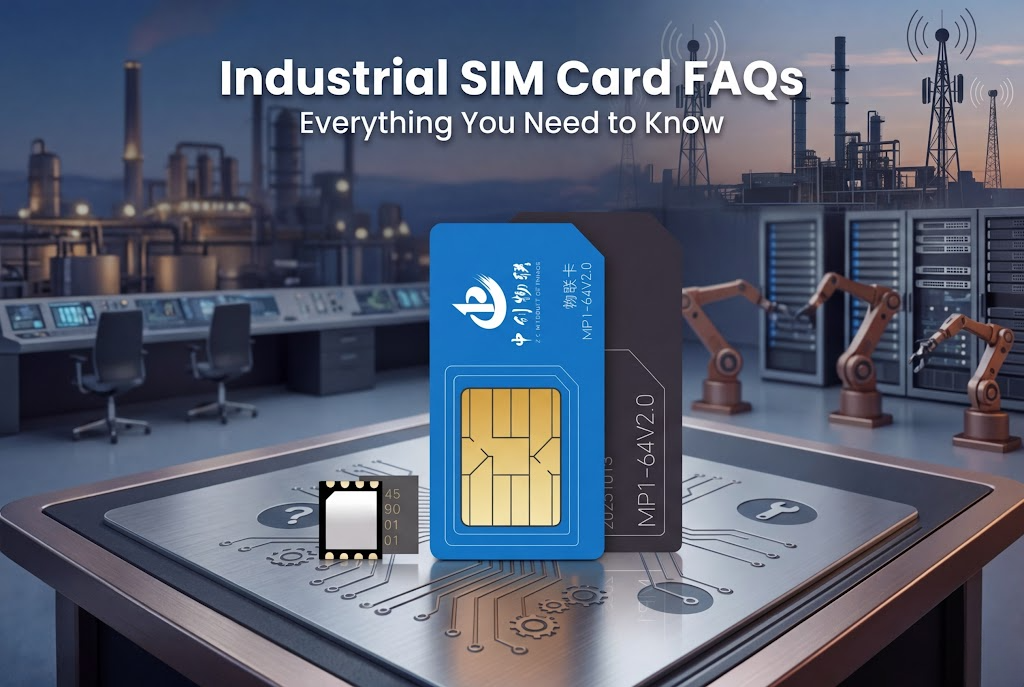
When devices sit in sealed enclosures, remote fields, or vibrating machinery, connectivity failures are expensive. An industrial SIM card is built for this reality. This guide answers common buyer questions, explains key specs, and shows what to check before you scale an Industrial IoT rollout.
Why Industrial SIM Cards Matter More as IoT Scales?
IoT Analytics estimates connected IoT devices will reach 21.1 billion by the end of 2025 and 39 billion in 2030[1]. GSMA Intelligence forecasts 38.7 billion total IoT connections by 2030, with enterprise connections accounting for 63% of the total[2].
At scale, the SIM becomes part of reliability engineering. Industrial IoT SIMs must meet requirements such as extended temperature ranges (up to 105°C), longer lifespans, and more erase/write cycles than typical consumer use.
What is an Industrial SIM Card?
An industrial SIM (often called an M2M SIM) is a SIM or eUICC designed for machine-to-machine communication where the device may be unattended for years and exposed to harsh conditions. Operator product sheets describe M2M SIMs as built for extreme environments (for example, -40°C to +105°C), and for a longer practical service life by using higher read/write endurance than regular SIMs.
Industrial grade is about hardware resilience and lifecycle, not just “business data plans.” For example, a standard commercial SIM lists an operating temperature range of -25°C to +85°C and endurance figures around 100,000 erase/write cycles (with some files rated higher). That can be acceptable for phones, but it is a risk for devices that face repeated OTA updates, status writes, or environmental stress over many years.
Industrial SIM vs. Consumer SIM
The table below summarizes typical differences using public operator and industrial SIM datasheets. Exact figures vary by vendor and grade, so treat this as a requirement starter, not a guarantee.
| What You Compare | Consumer or Standard Commercial SIM (typical) | Industrial or M2M SIM (typical) |
| Operating temperature | -25°C to +85°C | -40°C to +105°C (common industrial grade) |
| Endurance (erase/write cycles) | ~100,000 cycles (some “hot” files higher) | 500,000 cycles and up; some operator M2M SIMs cite multi-million cycles |
| Form factors | Mostly removable 2FF/3FF/4FF | Removable plus embedded solderable options (often MFF2) |
| Operations | Individual user usage | Fleet management and bulk operations |
Read more: IoT SIM vs. Consumer SIM: Why Industrial Routers Need M2M Data Plans
The Specifications That Decide Success
1. Form Factor and Mechanical Risk
If your device is exposed to vibration, moisture, or tampering, embedded options are worth considering. eUICC hardware datasheets reference ETSI standards (for example, ETSI TS 102 221 and ETSI TS 102 671) for UICC physical and interface characteristics, and note that MFF2 packages are intended to be mounted on a PCB.
A common buyer approach is: removable (2FF/3FF/4FF) for serviceable devices, MFF2 when the device must stay sealed or vibration-resistant for years.
Explore more: IoT SIM Card Form Factors: 1FF, 2FF, 3FF, Nano (4FF) and MFF2
2. eSIM and Remote Provisioning
If you deploy globally, carrier changes are a lifetime event, not a one-time purchasing step. A 2023 explainer from IDEMIA says GSMA published SGP.31 to support remote provisioning of eUICCs in network- and user-interface-constrained IoT devices, while reusing SM-DP+ and API building blocks familiar from consumer eSIM. It also describes a key business benefit: remotely downloading a local operator profile to reduce roaming costs and avoid permanent roaming issues, without physically replacing the SIM[3].
3. Low-power Connectivity
For battery-powered sensors, verify technology support (LTE-M, NB-IoT) at the plan and coverage level. Zhongyi IoT’s IoT SIM solutions support technologies from 2G to 5G, including LTE-M and NB-IoT, and position these as options for low-power and hard-to-reach devices.
4. Security Assurance Signals
SIMs store authentication credentials, so security is part of procurement. Industrial SIM datasheets commonly include security features and certifications (some call out Common Criteria levels) alongside environmental ratings and endurance.
A compact RFP checklist:
• Temperature range and installation environment
• Form factor and sealing requirements
• Required network technologies (including LTE-M or NB-IoT if needed)
• Fleet operations: portal, API, alerts, bulk tools
Industrial SIM Card FAQs for Global Buyers
1. Are IoT SIM cards generally used only for data transmission?
IoT SIM cards are primarily designed for data communication between devices. In many deployments, they are used mainly to send telemetry, status updates, and control data rather than to support consumer-style calling or texting. However, whether voice or SMS is available depends on the carrier and plan.
2. Can I use an IoT SIM in a smartphone?
Technically speaking, a smartphone can recognize and use an IoT SIM card to access the internet, but the performance is often poor. The reason is that such cards are optimized for device communication, and voice or SMS functions may not be enabled. In addition, mobile carriers may detect “non-IoT usage” and restrict or suspend the connection. Simply put, it may work when inserted into a phone, but it is not designed for that purpose.
3. What does “multi-network” or “multi-IMSI” mean?
This refers to a technology that allows a device to automatically switch between different mobile carriers. For example, when a device moves to an area where one carrier’s signal is weak, it can automatically connect to another carrier with a stronger signal to maintain uninterrupted data transmission. A “multi-IMSI” SIM card can have multiple network identities on a single card, equivalent to having access to multiple carriers.
4. What should IoT SIM cards for business include beyond the SIM itself?
For businesses, centralized management and monitoring functions are more important. A good IoT SIM service usually provides an online management platform that allows enterprises to activate or deactivate device connections, monitor data usage and status, set up abnormal alerts, and manage hundreds or thousands of SIM cards in bulk. This helps control costs and makes operation and maintenance more efficient.
5. How do I plan usage for IoT SIM cards for industrial automation?
When planning data usage, two types of communication need to be considered: routine small-data communication (steady-state transmission), such as temperature or status data; and occasional large-data communication (burst traffic), such as device updates, remote diagnostics, or error retransmissions. Based on this, enterprises can choose suitable billing methods, such as monthly or annual plans, pay-per-use data plans, or shared data pool packages.
6. Where is a SIM card for industrial IoT solutions most commonly used?
These SIM cards are often used in scenarios that require remote monitoring and data collection, such as smart electricity, water, and gas meters, logistics tracking and fleet management, industrial equipment monitoring, and smart city infrastructure like connected streetlights or parking spaces. These devices are usually widely distributed and numerous, so they require a reliable, easy-to-manage, and always-on communication method — which Zhongyi IoT IoT SIM cards are designed to provide.
Zhongyi IoT Industrial M2M SIM Card
At Zhongyi IoT, we designed our Industrial M2M SIM card to support demanding IoT deployments that require reliable connectivity, long-term durability, and easier remote management. We aim to provide a solution that can better adapt to industrial environments, especially where network stability, low-latency M2M communication, and operational efficiency matter.
To help customers evaluate whether our solution is a good fit, we also share several practical service details that may be useful during vendor comparison or pilot planning.
| What We Offer | What It Means in Practice |
| Multi-network connectivity with automatic switching | Helps improve resilience when one carrier has weaker signal quality |
| Roaming coverage | Coverages in more than 200 countries and regions |
| Management tools | A web platform and API for activation, status control, monitoring, alerts, and bulk operations |
| Flexible plans | Monthly, yearly, pay-per-data, shared pool, and roaming package options |
| Trial program | 3 test SIM cards with a 7 to 15-day free trial |
If you are shortlisting providers, run a pilot that tests coverage in real installation locations, plus workflows like activation, alerting, and billing reconciliation. Zhongyi IoT’s published trial offer and cloud management approach can help you validate fit before committing to a large rollout.
References:
[1] State of IoT 2025: Number of connected IoT devices growing 14% to 21.1 billion globally. Available at: https://iot-analytics.com/number-connected-iot-devices/(Accessed: 31 March 2026)
[2] IoT market forecast to 2030: connections by region and vertical. Available at: https://www.gsmaintelligence.com/research/iot-market-forecast-to-2030-connections-by-region-and-vertical (Accessed: 31 March 2026)
[3] How will the GSMA’s new eSIM Consumer IoT specification pave the way for massive IoT? Available at: https://idemia.com/pdf-export.php?post_id=10554 (Accessed: 31 March 2026)
![Why 2G/3G/4G Backward Compatibility Still Matters for IoT in the 5G Era Alt: 2G/3G/4G in the 5G Era In the rush toward 5G and IoT (Internet of Things), it's easy to overlook the older networks that still power millions of devices. In the 5G era, backward compatibility with 2G/3G/4G remains crucial for IoT, primarily to ensure the proper operation of existing devices, provide wider coverage, reduce energy consumption and costs, and support a smooth transition. The Enduring Role of 2G/3G in a 5G World The shift to 5G is accelerating[1,2]. However, backward compatibility is not just about nostalgia; for several key reasons, it remains necessary both now and in the coming years: 1.Protecting the Online Operation of Existing IoT Devices Currently, there are hundreds of millions of IoT devices worldwide (such as smart electricity meters, water meters, gas meters, asset trackers, vehicle T-Boxes, alarm systems, etc.) that only support 2G, 3G, or 4G and lack 5G capabilities. Without backward compatibility or fallback to 2G/3G/4G, once operators shut down these legacy networks, devices will go offline directly, leading to business disruptions and security risks. 2.Coverage and Network Continuity In many rural, remote, or developing regions, 5G coverage is still limited, and even 4G is not fully available, while 2G/3G remains the most reliable wide-area communication method. Multi-mode NB‑IoT, LTE‑M, or Cat‑1/Cat‑4 modules supporting 2G/3G/4G can: Automatically downgrade to 4G, 3G, or 2G where 5G signals are weak Ensure devices such as vehicle trackers, logistics and warehouse monitors, and field environmental sensors “never go offline.” 3.Power Consumption and Battery Life Advantages 2G remains very efficient in low-speed, low-power scenarios. Some sensors or trackers using 2G solutions can operate 5–10 years without battery replacement. In comparison, 4G/5G consumes significantly more power in low-data scenarios. Therefore, retaining backward compatibility with 2G/3G/4G continues to provide the “most energy-efficient” connectivity option for low-power, long-lasting IoT devices. 4.Cost and Upgrade Pace Control The hardware costs and development thresholds for 2G/3G/4G modules and terminals are much lower than those for 5G modules, especially for high-volume, low-unit-price IoT products. With multi-mode and multi-band compatible modules, enterprises can: Gradually replace old devices with new 4G/5G modules over the next few years Instead of a “one-time replacement” when 2G/3G networks are shut down, thus controlling capital expenditure and operational costs 5. Transition Strategy and Network Downgrade Redundancy Backward-compatible multi-mode modules (supporting 2G/3G/4G/5G) provide flexibility for operators and customers: Operators can gradually shut down 2G/3G networks by country or region, first using 4G/5G for new services, while legacy devices continue to operate via downgraded connections; Devices can automatically downgrade to 4G/3G/2G when 5G signals are weak or congested, ensuring critical data is uploaded on time and avoiding the “high bandwidth but unreliable” problem. Practical Migration Paths The solution isn't to halt progress but to migrate strategically. Here’s how the industry is bridging the gap: Migration Path Terminology Core Advantages Use Cases Deployment Status(2026) LTE Cat-1 bis LTE Category 1 bis Simplified low-cost version of LTE 4G networks (bis = secondary optimized version) Leverages existing 4G base stations, moderate speed (10Mbps downlink), global roaming, low-cost modules Medium data volume IoT (e.g., POS terminals, vehicle tracking) Mainstream transition solution, covers all 4G areas LTE-M LTE-MTC (Machine Type Communication) Supports mobility, voice (VoLTE), 1Mbps speed, moderate penetration Mobile devices, voice-enabled IoT Strong coverage in Americas; expanding in Asia/Europe NB-IoT Narrowband IoT (Narrowband Internet of Things, single base station supports massive connections) Ultra-low power, strong penetration (+20dB), static low data rate (20-250kbps) Static sensors (e.g., meters, water meters, environmental monitoring) Leading deployment in Asia/Europe; limited in Americas 5G RedCap 5G Reduced Capability (eRedCap=enhanced version) Upgraded from Cat-1 bis, 150Mbps downlink, low power, massive connections Mid-to-high-end IoT requiring higher performance Commercial rollout starting 2026 in 5G coverage areas 5G NR mMTC 5G New Radio - massive Machine Type Communication 1M connections/km², ultra-low latency, network slicing Industry 4.0, smart cities Mature 5G network regions eSIM SGP.32 GSMA SGP.32 IoT eSIM (embedded SIM) international standard Remote operator switching, no card swaps needed, global roaming All cross-border IoT deployments Mainstream IoT eSIM standard in 2026 Contact Zhongyi IoT for IoT Connectivity Solutions From leveraging LTE Cat-1 bis for stability today to adopting flexible 5G eSIM solutions for tomorrow, businesses must ensure continuity while preparing for long-term evolution. This is why partnering with one of the top IoT connectivity providers is essential. Zhongyi IoT delivers a comprehensive IoT connectivity service designed to support seamless migration, global coverage, and remote management. To discover how the comprehensive IoT connectivity service can future-proof your deployments, visit Zhongyi IoT. References: [1]2G / 3G Network Shutdown Status and Challenges. Available at: https://www.smartviser.com/post/2g-3gnetworkshutdown [2]Technology upgrades and legacy network sunsets on the rise. Available at: https://www.gsma.com/connectivity-for-good/spectrum/technology-upgrades-and-legacy-network-sunsets-on-the-rise/ TDK SEO Title: Why 2G/3G/4G Backward Compatibility Still Matters for IoT in the 5G Era SEO Keywords: 5G and IoT, 2G 3G 4G, eSIM, IoT connectivity providers, IoT connectivity service SEO Description: Discover why maintaining 2G/3G/4G support is essential for IoT devices in the 5G era, and learn about multiple migration paths such as LTE Cat-1 bis, LTE-M, NB-IoT, and eSIM SGP.32. URL: /2g-3g-4g-backward-compatibility-matters-for-iot-5g-era/](https://www.zyiotnet.com/wp-content/uploads/2026/03/2g-3g-4g-in-the-5g-era.png)