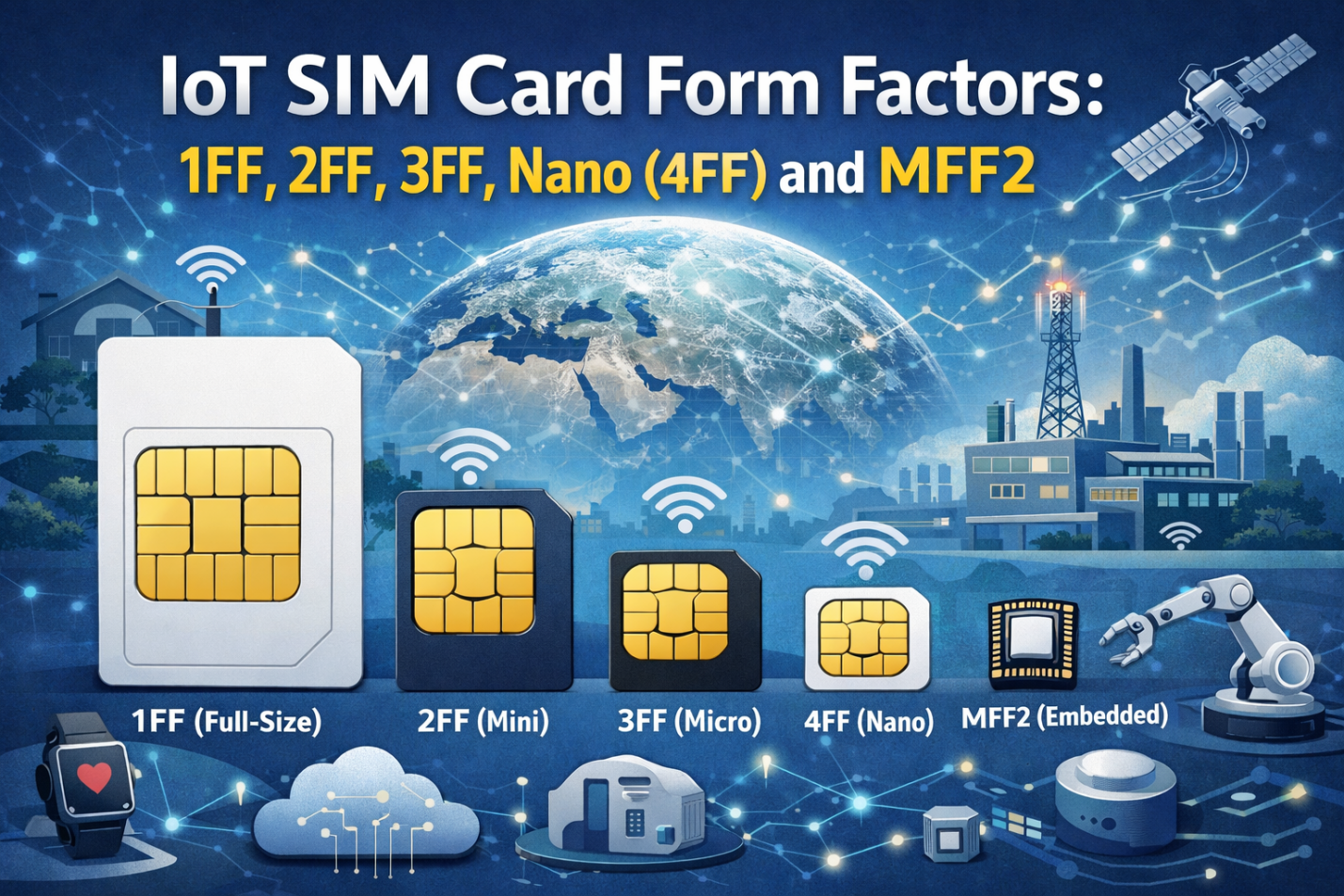
Selecting the right IoT SIM card form factor is critical for device longevity and performance. Whether you are designing compact wearables or rugged industrial machinery, understanding the differences between 1FF, 2FF, 3FF, 4FF, and MFF2 is essential for hardware compatibility.
At Zhongyi IoT, we provide the expertise needed to ensure seamless connectivity for your global IoT SIM card deployments across any environment.
Understanding IoT SIM Card Form Factors
In the world of the Internet of Things (IoT), “one size fits all” does not apply. The physical size and mounting method of a SIM card—known as its form factor—directly impact the device’s design, durability, and maintenance requirements.
While the internal chip functionality remains consistent across most sizes, the external packaging has evolved significantly.
(1) Removable SIM Cards (1FF to 4FF)
For many applications, removable SIMs offer the flexibility of easy replacement and manual testing. As devices have shrunk, so have these cards.
| Form Factor | Name | Dimensions (L×W×T) | Common Use Cases |
| 1FF | Full-Size | 85.60mm×53.98mm×0.76mm | Obsolete (early mobile phones) |
| 2FF | Mini-SIM | 25mm×15mm×0.76mm | Industrial routers, ATMs, Vending machines |
| 3FF | Micro-SIM | 15mm×12mm×0.76mm | Tablets, GPS trackers, Smart meters |
| 4FF | Nano-SIM | 12.3mm×8.8mm×0.67mm | Asset trackers, Smartwatches, Mobile IoT |
While 4FF (Nano) is the smallest removable option, it requires a card slot, which may be a point of failure in high-vibration environments.
(2) MFF2: The Industrial Standard for Embedded SIMs
The MFF2 (Machine-to-Machine Form Factor), often referred to as an eSIM, is a surface-mount chip soldered directly onto the device’s printed circuit board (PCB). Measuring approximately 6mm×5mm, it is significantly more robust than its removable counterparts.
- Vibration Resistance: Soldered connections eliminate the risk of contact loss in moving vehicles or heavy machinery.
- Security: Since the SIM is inside the device casing and soldered down, it is nearly impossible to steal or tamper with it physically.
- Longevity: MFF2 chips are often “industrial-grade,” supporting temperature ranges from -40℃ to +105℃.
Why Form Factor Matters for a Global IoT SIM Card
When deploying a global IoT SIM card, the choice of form factor often dictates the logistical ease of your project. If your hardware is deployed in remote or harsh locations, MFF2 or high-grade 2FF cards are preferred for their environmental resistance.
For businesses looking for an IoT SIM card USA solution or European deployments, regional hardware standards might influence your choice. For instance, compact urban sensors in the USA frequently utilize 4FF or MFF2 to save space while maintaining high-speed 4G/5G connectivity.
Advanced Technology: eUICC and Multi-IMSI
The physical form factor is only half the story. The software inside, specifically eUICC (Embedded Universal Integrated Circuit Card), allows you to switch carriers over-the-air (OTA). This means an MFF2 chip soldered in a factory in Asia can be “reprogrammed” with local IoT SIM card plans once it arrives in the USA or Europe, eliminating the need for expensive “truck rolls” to change physical cards.
Zhongyi IoT Benefits:
- Remote Provisioning: Support for SGP.32 standards to manage large fleets automatically.
- Multi-IMSI Capability: Pre-loaded with multiple network profiles to ensure your device stays connected even if a primary carrier fails.
Choosing the Right IoT SIM Card Plans
Selecting a form factor should go hand-in-hand with choosing the right IoT SIM card plans. High-data applications like video surveillance might require larger, more heat-efficient modules, while low-power wide-area (LPWA) sensors for smart agriculture can thrive on the tiniest MFF2 or even iSIM (Integrated SIM) solutions.
Actionable Tips for Selection:
- Assess the Environment: Use MFF2 for industrial settings with high humidity, dust, or vibration.
- Evaluate Space: Use 4FF or iSIM for ultra-compact wearables.
- Future-Proof with eUICC: Regardless of the size, ensure the card supports eUICC to avoid being locked into a single carrier for the 10-15 year lifespan of the device.
Conclusion
From the classic Mini-SIM (2FF) to the modern MFF2, the choice of form factor is a foundational decision in IoT hardware design. By matching the physical durability of the card with advanced eUICC software and flexible IoT SIM card plans, businesses can ensure their global deployments remain reliable and cost-effective.
Ready to streamline your connectivity? Contact Zhongyi IoT today to find the perfect SIM solution for your next project and get a custom quote for your global deployment needs.