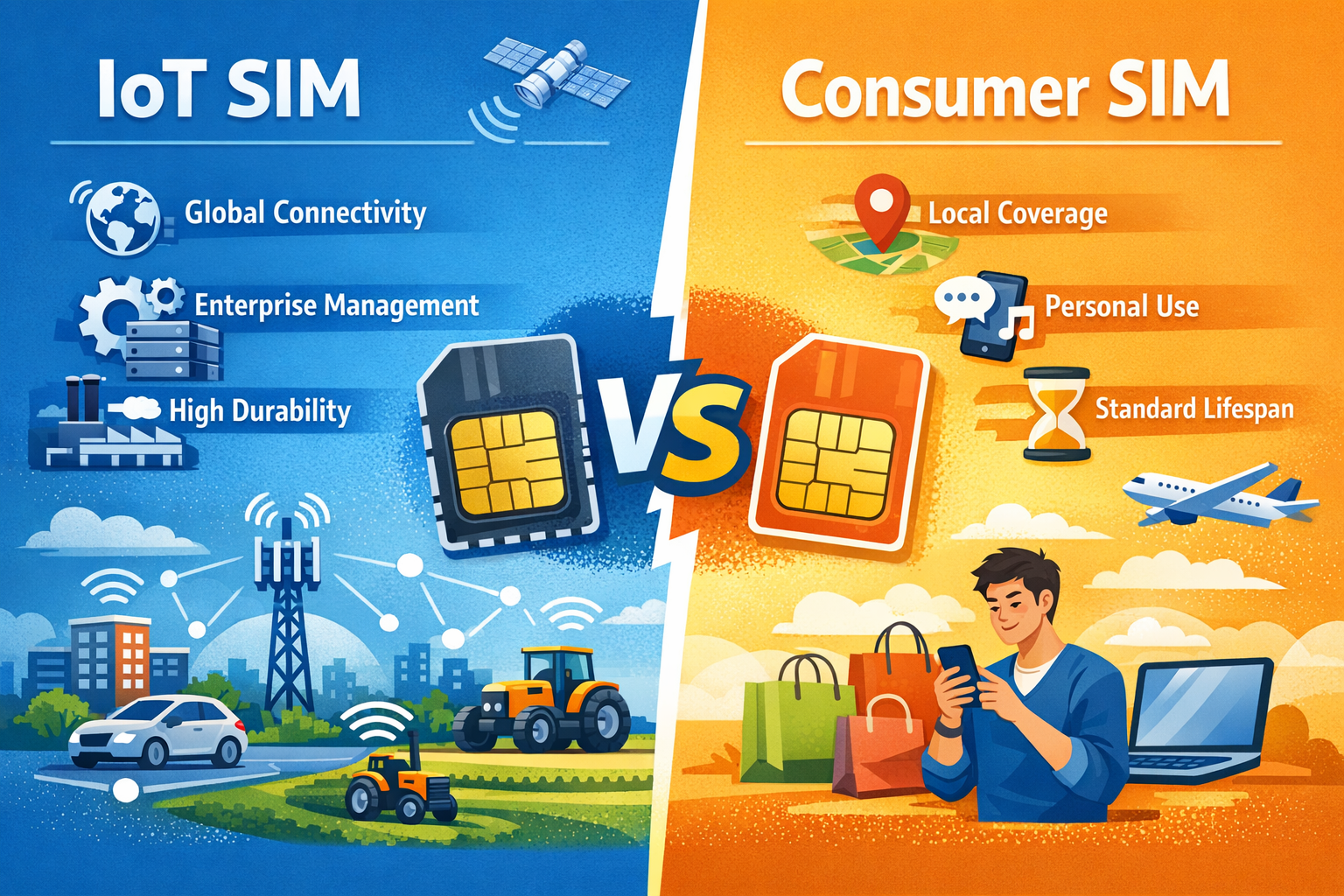
Choosing the right connectivity is as vital as the hardware itself in the burgeoning era of Industrial IoT (IIoT). While consumer SIMs work for smartphones, industrial routers demand specialized IoT SIM cards to ensure reliability. This guide explores why businesses must transition to M2M data plans and specialized connectivity providers to safeguard their mission-critical operations.
The Connectivity Gap
For many businesses, the temptation to use a standard consumer SIM card in an industrial router is high, primarily due to perceived cost savings or immediate availability. However, this “quick fix” often leads to catastrophic failures in the field. Industrial environments—ranging from remote oil rigs to high-speed manufacturing floors—present challenges that consumer-grade technology was never built to handle.
To understand why a professional SIM IoT solution is mandatory, we must look at the fundamental architecture of Machine-to-Machine (M2M) communication versus human-centric mobile usage.
1. Physical Durability: Built for the Extremes
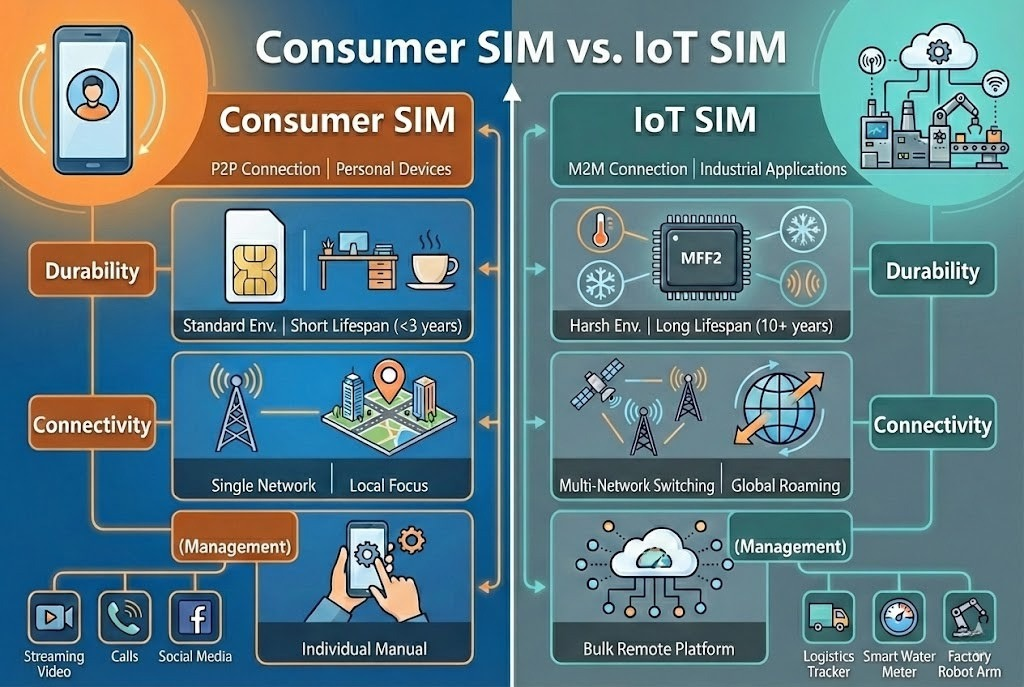
Consumer SIM cards are designed for controlled environments: pockets, purses, and air-conditioned offices. In contrast, IoT SIM cards are engineered as “hardened” hardware.
Industrial-Grade Specifications
Standard consumer SIMs typically operate within a narrow temperature range (approx. -25°C to +85°C). Industrial-grade SIMs, such as those provided by Zhongyi IoT, are built to withstand:
- Extreme Temperatures: Reliable operation from -40°C to +105°C.
- Physical Stress: High resistance to vibration, humidity, and corrosion.
- Longevity: A consumer SIM is designed for a 2–3 year lifecycle (the average age of a smartphone). An IoT SIM is built for a 10-year+ lifespan, with data retention capabilities reaching up to 25 years.
For an industrial router deployed in a remote utility substation, the cost of a truck roll to replace a degraded consumer SIM far outweighs any initial savings.
2. Global Connectivity and Network Reliability
One of the most significant advantages of partnering with an IoT connectivity provider is access to “Non-steered” Multi-network Roaming.
The Problem with Consumer “Lock-in”
Consumer SIMs are typically locked to a single home carrier. If that carrier has a localized outage or poor signal in a specific industrial zone, the router goes offline.
Multi-Network Resilience
Professional IoT SIM solutions allow for:
- Automatic Switching: The SIM detects the strongest available signal across multiple carriers (covering over 190 countries and 800+ networks) and switches automatically to maintain a 99.9% uptime.
- Network Priority: During periods of high network congestion (e.g., a public event or emergency), carriers often throttle consumer traffic. However, M2M traffic on industrial APNs is frequently given higher priority to ensure critical data packets reach their destination.
3. M2M Data Plans: Flexibility and Cost Control
Consumer data plans are structured around high-bandwidth “all-you-can-eat” models designed for video streaming and social media. Industrial applications have vastly different requirements.
The Power of Data Pooling
In an industrial setup, you might have 1,000 routers. Some might use 5MB a month, while others use 500MB due to varying diagnostic needs.
- Consumer Model: You pay for 1,000 individual plans. If one goes over, you pay heavy overage fees.
- M2M Data Pooling: All 1,000 IoT SIM cards share a single “pool” of data. The low usage of one device offsets the high usage of another, dramatically reducing the total cost of ownership (TCO).
Furthermore, M2M plans offer “Lifecycle Management,” allowing administrators to pause, resume, or terminate subscriptions instantly via a management platform—a feature absent in the consumer retail market.
4. Security: Beyond the Public Internet
For any industrial enterprise, security is the primary concern. Consumer SIMs operate on public Access Point Names (APNs), making them visible and vulnerable to the open internet.
Private APNs and Static IPs
An IoT connectivity provider like Zhongyi IoT offers specialized security layers:
- Private APN: This creates a private “tunnel” for your data, isolating your industrial traffic from public internet threats.
- Fixed Static IP: Unlike consumer devices that change IPs frequently, a static IP allows technical teams to remotely access, diagnose, and update industrial routers located in the field.
- VPN Integration: Data can be encrypted from the SIM level to the corporate cloud, ensuring end-to-end integrity.
5. Centralized Management: The CMP Advantage
Managing five smartphones is easy; managing 5,000 industrial sensors is a logistical nightmare without a Centralized Management Platform (CMP).
A professional SIM IoT solution includes a dashboard that provides:
- Real-time Monitoring: Track data usage and signal strength for every device globally.
- IMEI Whitelisting: Lock a SIM to a specific router. If the SIM is stolen and put into another device, it will automatically deactivate.
- Automated Alerts: Receive notifications if a device moves outside its “Geo-fence” or exceeds a data threshold.
6. Technical Evolution: From Removable SIMs to eSIM and iSIM
The industry is moving toward more integrated solutions. The GSMA has defined specific standards to govern this evolution:
- SGP.02 (M2M): A “Push” model for remote profile management, ideal for sealed industrial units.
- SGP.32 (Latest IoT Standard): A newer standard designed to make it easier for constrained IoT devices to switch carriers over-the-air (OTA).
eSIM (MFF2) technology is particularly relevant for industrial routers. Since the “chip” is soldered directly onto the circuit board, it is immune to the vibration issues that can plague traditional “plug-in” SIM cards in moving vehicles or heavy machinery.
Conclusion: Investing in Industrial ROI
To use a metaphor: a consumer SIM is like a city bus pass—it is affordable and works well on established routes, but it cannot go off-road or cross borders easily. An IoT SIM paired with an M2M data plan is like an all-terrain, armored logistics fleet with a private satellite uplink. It is designed to go anywhere, survive anything, and always stay connected.
For businesses looking to scale, Zhongyi IoT provides the robust IoT SIM hardware and global connectivity infrastructure required to turn a simple router into a powerful industrial asset. By prioritizing durability, security, and flexible data pooling, companies can ensure their digital transformation is built on a foundation of reliability.